
L&D Budget as a % of Revenue: A Simple Framework
When you last opened your budget, did ‘Employee Development’ even show up as its own line item? Or was it buried under ‘HR,’ ‘People Ops’, or a vague catch-all like ‘Training’? If it wasn’t clearly visible, that’s the first warning sign. Capability doesn’t improve by accident. It grows when it’s planned, funded, and treated like business infrastructure.
Before we talk numbers, ask yourself this: Do we treat development as a strategic investment? If your answer is no, the way you approach the conversation should come from a very different place then if you answered ‘yes’.
We know from research from Wharton that employee capability isn’t a oneoff expense. It is a compounding asset, because new skills and knowledge build on what has come before, increasing expertise and performance over time. For example, a recent Australian HR Institute survey found that 57 % of employers believe skills gaps are harming productivity, and almost one in five workers are considered not fully proficient in their roles, contributing to higher turnover and slowed organisational performance. The commercial translation leads to projects stalling, leaders stretched thin, turnover rising, and customer experience becoming inconsistent.
Invest well, and the commercial outcomes are clear and measurable.
The Hidden Cost of Underinvestment in Learning
Evidence consistently shows that the return is not abstract or “soft.” It shows up in revenue, productivity, and retention, the metrics that matter most to the business. Deakin and Deloitte suggests that organisations who invest early and intentionally in learning and development see tangible business gains, with every $1 invested per employee in L&D associated with an average of $4.70 in additional revenue and linked to stronger retention and productivity outcomes. This investment is also strongly linked to improved employee retention and higher productivity, particularly when learning is embedded early and aligned to organisational strategy rather than delivered reactively.
Sounds great in theory, right? But how do organisations execute?
Enter Learning & Organisational Development (L&OD). L&OD is the organisational function focused on building employee capability, performance and future readiness. L&OD equips people with the skills, knowledge and behaviours they need to perform today and grow for tomorrow. It covers everything from onboarding and technical training to leadership development, coaching, capability frameworks and learning systems, ensuring employees stay skilled, engaged and aligned with organisational goals while reducing skill gaps and strengthening retention.
Think of L&OD like IT or facilities: it’s essential infrastructure that keeps the business moving forward.
What High-Performing Organisations Invest (3%+)
Many organisations set and forget their L&OD (Learning and Organisational Development) budget, often linking to technical training. It becomes a fixed dollar amount which often feels ‘safe’ as fits neatly into your profit and loss (P&L) spreadsheet. People rarely raise an eyebrow to year-on-year budget bucketing. The problem here is as your business grows, but your budget doesn’t.
Imagine an elite sports team. Would they ever say: “Our training budget is $200,000, forever”? Of course not. They scale their investment based on the level they want to play at, the talent they need to retain, the competition they face, and their strategic goals for the season. As teams move into higher divisions, their training budgets move too.
When your investment remains flat while revenue, headcount, and complexity increase, a few things happen.
- Fewer people get access to development.
- Training that was once broadly available has now become a privilege for a select few.
- The organisation unintentionally signals that growing capability isn’t a priority as the business expands.
High performance requires being one step ahead, not one step behind. Yet many organisations grow while still training people at yesterday’s level. Setting your L&D spend as a percentage of revenue ensures capability grows alongside your business. Development becomes inclusive rather than exclusive, high performers are continually stretched, leaders stay ahead of complexity, and your culture signals: “We expect excellence and we invest to support it.”
Investing in L&D strategically is about building future-ready capability: if you want your organisation to perform at tomorrow’s level, your people need development that prepares them today.
A Simple %-of-Revenue Budget Model
What’s the “Right” Percentage?
According to a recent report by Society for Human Resource Management (SHRM), the median spend on L&D per fulltime employee (FTE) is about US $414 per employee annually, though this varies by industry. Companies that prioritise learning and development report higher profit margins, better shareholder returns, faster innovation, stronger customer satisfaction, and higher retention. Investing in career development and skill-building directly supports an organisation’s highest objectives by driving productivity and profits.
In practice, targeted L&D spending therefore delivers measurable business impact. It grows capability, improves performance, and produces a strong return on investment, so leaders should treat development as a strategic productivity and profit lever rather than a discretionary cost. Below, we have a case study detailing impact in practice.
When Averages Don’t Apply
Not all organisations fit the benchmarks. For instance:
- When organisations are growing fast, they need capability at speed, which means higher learning investment to ensure leaders stay agile and supported.
- Big shifts in strategy, culture, or technology demand strong investment in development to cultivate collaboration and position change as a positive step, not a disruption.
- Underperforming organisations must prioritise upskilling strategically.
- In highly competitive industries, capability and culture are key differentiators.
- Large frontline workforces need consistent, measurable training to protect operations and customer outcomes.
Organisations that successfully increase the capacity of workers to grow personally, use their imagination, and think deeply are 1.8 times more likely to report better financial results.
The Hidden Cost of Underinvestment
High-performing organisations treat development as infrastructure, not a perk. They invest early, build alignment, embed learning into daily work, and hold leaders accountable, resulting in the clarity, capability, energy and agility that lift performance, culture and revenue. Research and benchmarking consistently show that companies that prioritise continuous development outperform those that don’t, with stronger retention, faster promotion-readiness and better business outcomes.
Underinvesting in L&D is like running a sports team without coaching: execution slows, leadership gaps widen, engagement drops, turnover rises, customer experience suffers, and the culture becomes reactive rather than future-ready.
Imagine your organisation a year from now: what if your workforce is more capable than the business needs today? What opportunities would that unlock? And conversely, what will it cost if your people aren’t fully equipped for the challenges you expect next year? Most leaders feel the answer instinctively; use that instinct to prioritise where development will protect growth, reduce risk and create competitive advantage.
To help you strategise, we find these reflection questions helpful.
- Which three capabilities (if noticeably stronger across the business) would have the biggest positive impact on revenue, customer experience or risk reduction in the next 12 months?
- What is the likely organisational cost (in time, customer impact, and dollars) if those capabilities are not developed? and which teams would be most exposed?
- If you increased L&D investment to move from “just-in-time” to “one-step-ahead” development, what would success look like in 6 and 12 months (specific, measurable signals you’d expect to see)?
McKinsey research highlights that organisations that prioritise people development and continuous learning are better positioned to attract and retain talent, build a strong learning culture and improve key outcomes such as retention, talent mobility and engagement, all of which are core contributors to performance and longterm competitive advantage. Only about 36% of organisations qualify as “career development champions” in their peoplestrategy practices, meaning a minority run robust, resultsdriven development programs rather than patchy or adhoc activity.
To stay in the top-performing bracket, learning investment must be deliberate and consistent. Setting L&D as a fixed percentage of revenue keeps it scalable as the organisation grows and ensures capability-building remains a core priority rather than an optional extra. By committing to predictable, proportional funding, organisations embed development into their operational strategy, maintain alignment with business goals, and ensure employees are continually equipped to meet evolving challenges.
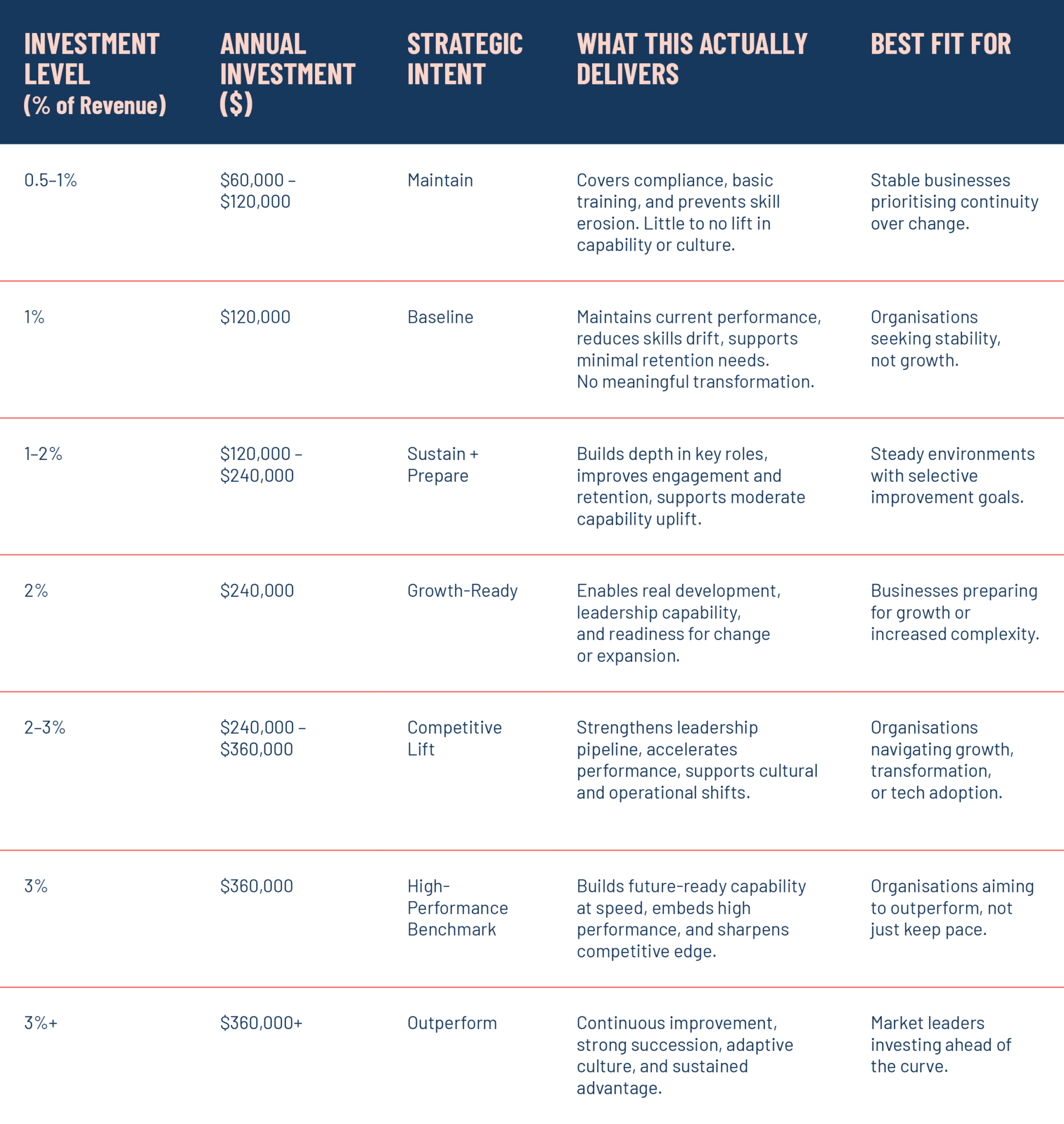
Investment should match ambition. A smaller percentage may maintain the status quo, but meaningful growth, transformation, or outperformance requires a higher allocation that reflects the real demands of change.
Example: Calculating L&D Budget in Real Dollars
Here’s a Simple Framework for Your Organisation using a $12m revenue business (revenue-based model), Aligning Capability Investment to Organisational Ambition
(Example: $12m annual revenue business)
What ROI to Expect From Your Learning Investment
As organisations grow and wage costs rise, the cost of not building capability internally escalates. A smart learning investment goes beyond simply completing training; it delivers measurable commercial outcomes that matter to leadership including higher productivity, improved retention and internal mobility, faster proficiency in critical roles, reduced reliance on external hires, and stronger leadership capacity to navigate change.
The benefits of development can be quantified. Development delivers measurable business benefits, so L&D should be treated as a strategic investment. Research and benchmarking show that allocating a fixed percentage of revenue to learning correlates with stronger retention, faster skill acquisition, and higher organisational performance. The next step is proving impact. Tracking outcomes from capability programs ensures the investment drives real commercial results and sets the foundation for smarter, future-focused learning decisions.