The short answer: predictive hiring means using validated behavioural and cognitive data at every stage of recruitment and selection. You define each role behaviourally before you advertise, assess every shortlisted candidate against it before interviews, and use the same data to onboard and manage the person you hire. The Predictive Index gives you one system to do all of it.
He interviewed really well. The CV was perfect. Six weeks in, you knew.
If that sounds familiar, you're in very good company. We hear a version of that story on almost every call we take.
That's no sign you're "bad at hiring". The standard hiring process asks your instincts to do something no instinct can: predict how a stranger will behave under pressure, months from now, from one hour of their best behaviour.
There's a better way, and it has seventy years of science behind it.
Why is hiring harder for Australian businesses in 2026?
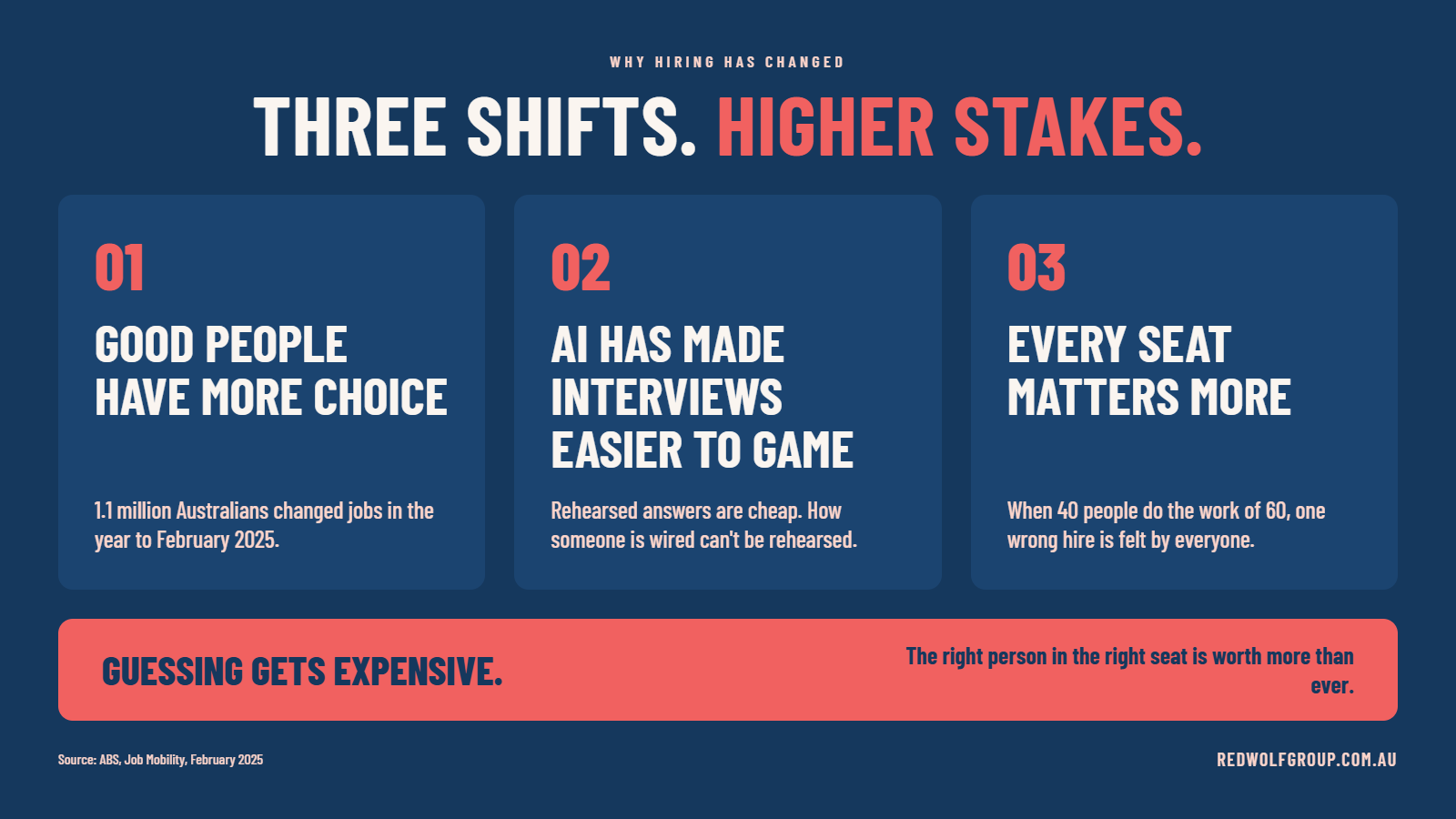
Three things have shifted at once.
Shift one: good people have more choice. About 1.1 million Australians (7.7% of workers) changed jobs in the year to February 2025 (ABS).
Average annual staff turnover sits around 15%, and 38% of organisations say they're struggling to recruit (AHRI, June 2025). The people you most want can leave as easily as they joined.
Shift two: AI has made interviews easier to game. A candidate can ask an AI tool for the ten smartest things to say about your industry the night before. They'll walk in sounding like an expert.
Rehearsed answers are cheap now. How someone is naturally wired to work, and how quickly they learn, can't be rehearsed.
Shift three: every seat matters more. Growing businesses want more output without hiring proportionally more people.
When a team of 40 is doing the work of 60, one wrong hire doesn't get absorbed. Everyone feels it.
Add those up and guessing gets expensive. In the age of AI, the right person in the right seat is worth more than ever.
Why don't interviews and CVs predict performance?
A CV tells you what someone has done. An interview tells you how well they present.
Neither tells you how they'll behave when the work gets hard, and that's what decides whether a hire works.
Three gaps usually sit behind a hire that goes wrong.
Gap one: the job was never defined. Three leaders sit on the interview panel, each with a different picture of the role. The candidate gets measured against all three pictures, and none of them.
Gap two: gut feel fills the space. Without a shared definition of the role, the decision comes down to who the panel liked most. Likeability is a poor predictor of performance.
Gap three: the assessment comes too late. Many businesses only test the final one or two candidates, after interviews, when everyone is already emotionally invested.
Testing after interviews is too late. By then, the data can only rubber-stamp a decision or make the room uncomfortable.
None of these gaps is a judgement problem. They're what happens when there's no hiring system.
What does a predictive recruitment and selection system look like?
The businesses that outperform their competitors get the best talent into the right roles, and then they keep them. It's rarely luck. They hire the same way, every time, for every role.
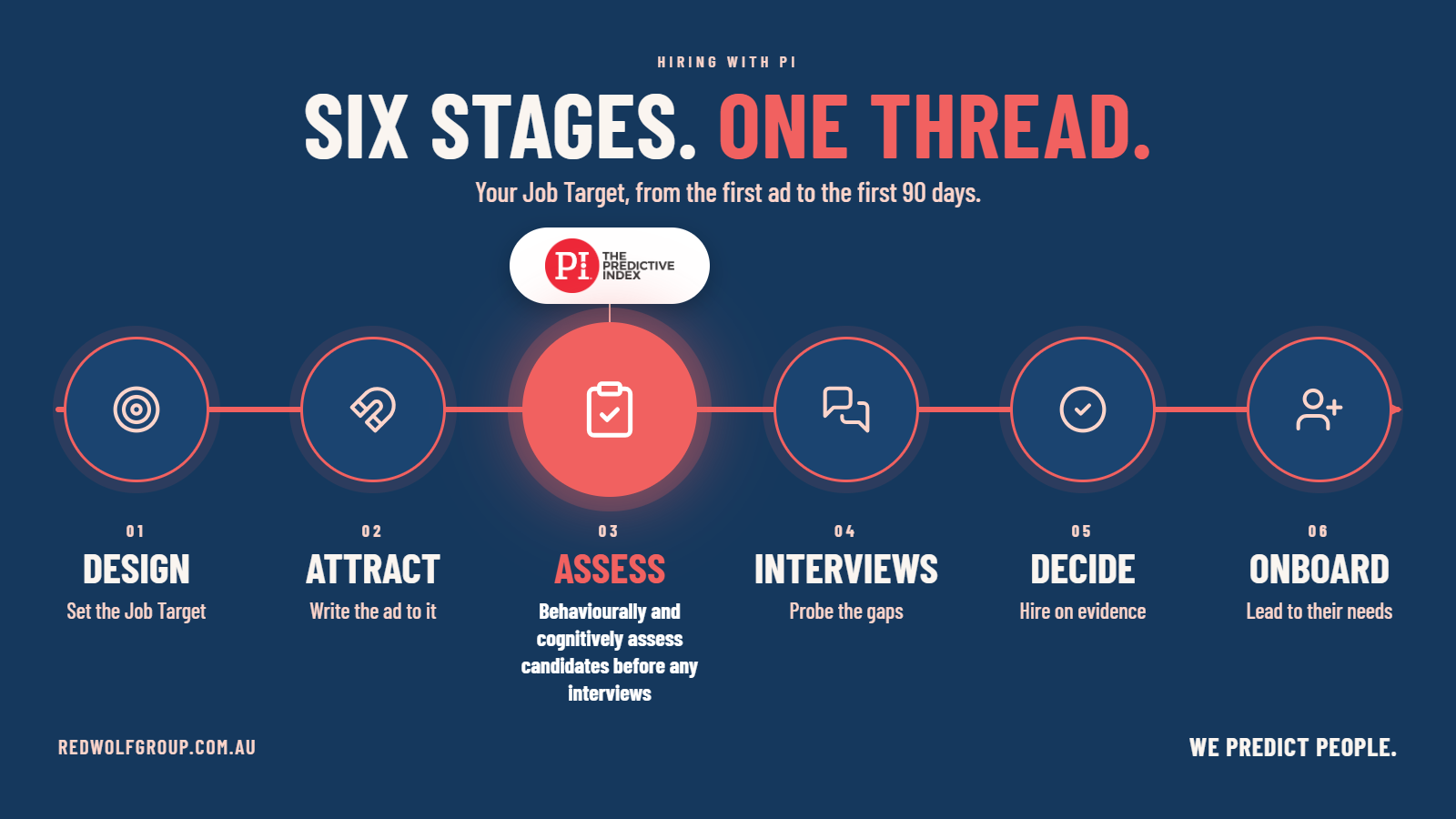
With the Predictive Index running through your recruitment and selection, every hire follows six stages:
- Design the role. The people who know the role best complete a short PI Job Assessment. Together you agree what behaviours and cognitive pace the seat actually needs, before anyone writes an ad.
- Attract the right people. You write the job ad to that profile, so it speaks to the people most likely to thrive in the role.
- Assess every shortlisted candidate early. Each candidate completes the PI Behavioural Assessment (about six minutes) and the PI Cognitive Assessment (12 minutes), before interviews.
- Interview to test real risks. Interview guides are built from each candidate's data, so your questions probe the specific gaps between the person and the role.
- Decide as a team. Your leaders compare candidates against the same job profile, with the same language, instead of debating gut feel.
- Onboard and manage with the same data. The new starter's manager already knows how they like to work, communicate and be managed from day one.
That end-to-end system is the gold standard. One assessment on one candidate helps; prediction across every role changes how your business hires.
Why does the system belong with your managers, not just HR?
PI goes to die with HR teams.
Don't get me wrong. HR teams are the biggest champions and support embed PI across all the processes internally. But we've seen the pattern for years. When only HR knows how to use PI, it becomes a report in the software. When that HR person moves on, PI leaves with them.
The businesses that get the most from predictive hiring put the data in their managers' hands. Managers profile their own roles, read their own candidates and use the data in every 1:1 after the hire.
That's why we train your people to run it themselves. We're the anti-consultant consultants: you'll have the tools, the language and the confidence to hire this way without us in the room.
Why do CEOs bring the Predictive Index with them to a new business?
We get this call often. A CEO starts at a new organisation, and one of their first calls is to us.
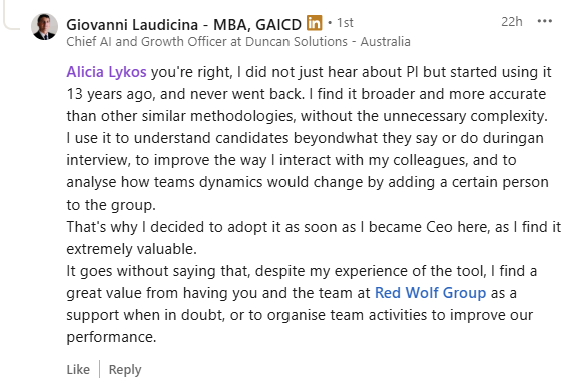
They used PI in their last business. They've seen what it does for hiring and for their managers, and they don't want to lead a new team without it.
Leaders who have hired with behavioural data rarely go back to hiring without it. Once you've seen a candidate's wiring before the interview, interviewing without that data feels like driving at night with the headlights off.
Can you really predict a great hire?
Yes. The person who glides through their role isn't a fluke of nature.
That effortless performer is what it looks like when someone is behaviourally built for the work: the right behaviours, the right cognitive capacity and the right skills. Unicorns can be predicted.
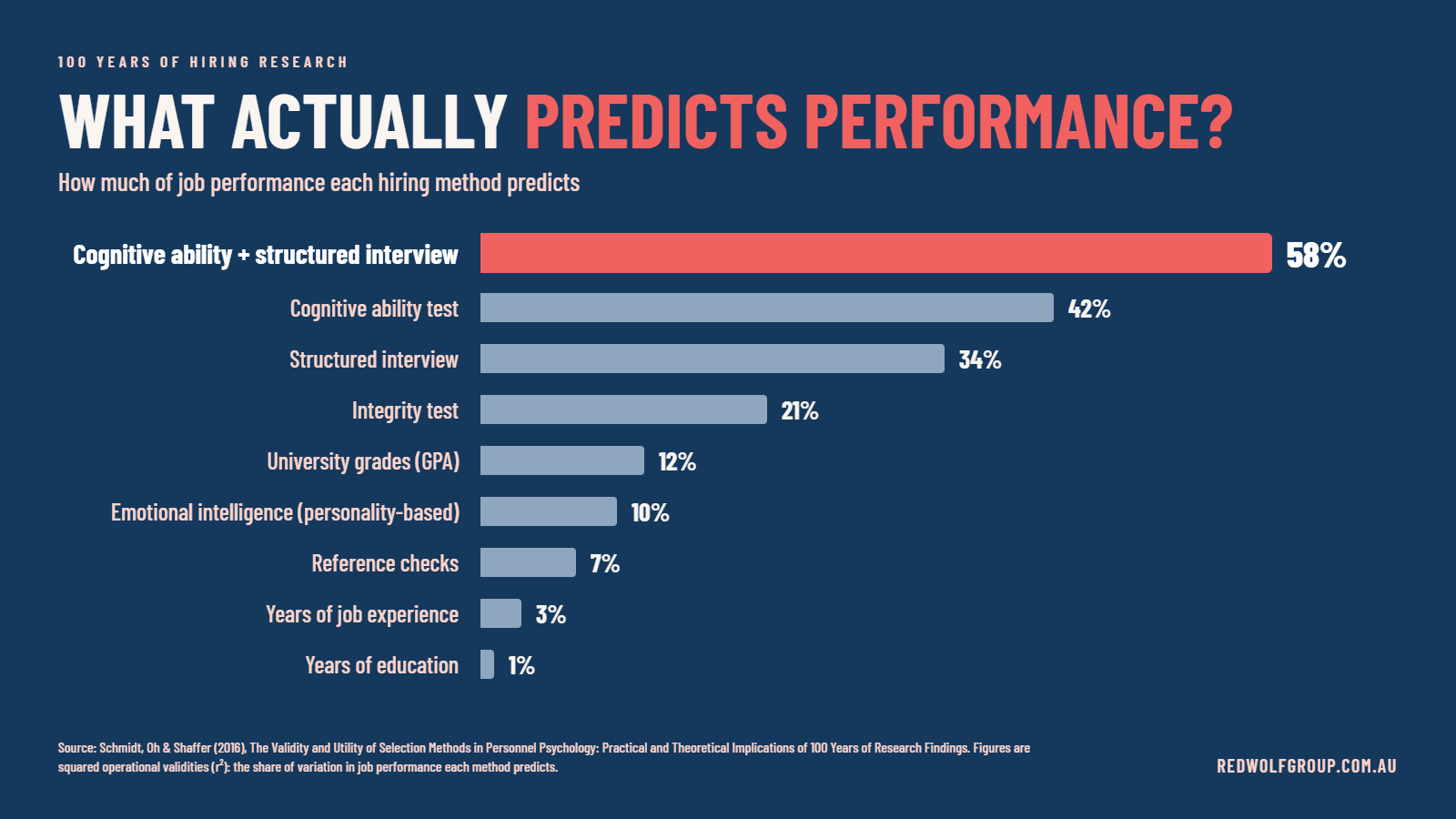
Decades of hiring research show that combining a cognitive ability measure with a structured interview predicts job performance far better than an interview alone.
Without PI, we wouldn't have been able to build our high performing team. - Scott Oxford, New Word Order. Case Study Here
Frequently asked questions
What is predictive hiring? Predictive hiring uses validated behavioural and cognitive data to forecast how a candidate will perform in a specific role. The data is used from role design through to onboarding, rather than as a one-off test.
Is the Predictive Index a personality test? No. PI is a validated, research-backed workplace assessment of natural behavioural drives, with a separate cognitive assessment that measures how quickly someone learns and adapts.
When should candidates do the assessment? Before interviews. Assessing early means the data shapes your interview questions, instead of arriving after you've already decided.
Who runs the system day to day? Your own managers and people team. We set it up, train your people and support them, so the capability stays inside your business.
Are you a recruitment agency? No. We don't find candidates for you. We help you build a hiring system that defines each role properly and predicts whether each person fits it.
Can we try it before committing? Yes. Predictable Hire lets you run one critical hire the predictive way, so you can see the data in action before you roll it out across the business.
Make prediction part of every hire
If you're ready to stop guessing, let's talk about building predictive hiring into your business. Book a chat with our team here.
Want to see it work first? Try it on one role with Predictable Hire.
Red Wolf Group is a Sydney-based people strategy and behavioural science consultancy and a Predictive Index Premier Partner since 2019, working across Australia and Asia Pacific.